
Mental Health Parity Law: What It Means for Your Insurance Coverage
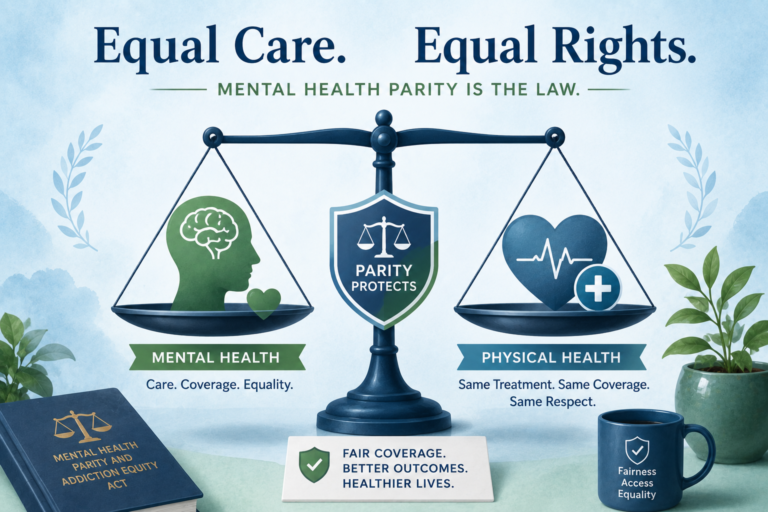
The Mental Health Parity and Addiction Equity Act (MHPAEA) is one of the most important consumer protection laws in American healthcare — and one of the least understood. It requires that insurance companies treat mental health benefits no less favorably than physical health benefits. Understanding this law empowers you to advocate for coverage you’re legally entitled to and appeal denials that may be illegal.
What the Mental Health Parity Law Requires
The MHPAEA applies to most employer-sponsored health plans and insurance sold in the individual and small group markets. It requires that insurance plans offering mental health and substance use disorder (MH/SUD) coverage must provide it on terms no more restrictive than medical/surgical coverage in these areas:
Financial Requirements (Quantitative Limits)
- Copays for mental health visits cannot be higher than copays for comparable medical specialist visits
- Deductibles for mental health services cannot be higher than for medical services
- Out-of-pocket maximums must apply equally to mental health and medical costs
Treatment Limitations (Non-Quantitative Limits)
- Prior authorization requirements cannot be more burdensome for mental health than for similar medical procedures
- Step therapy requirements (must try cheaper treatment first) must be comparable to medical standards
- Network adequacy — the insurer must maintain a sufficient network of mental health providers comparable to their medical network
- Out-of-network reimbursement rates must be comparable for mental health and medical providers
Visit Limits
- Annual session limits for therapy cannot be lower than visit limits for comparable medical care
- A plan that allows unlimited specialist visits for physical health cannot limit therapy to 20 sessions per year
The 2024 Parity Rule Strengthening
In September 2024, the Biden administration finalized a rule significantly strengthening MHPAEA enforcement. Key additions:
- Plans must now perform and document comparative analyses showing their mental health coverage isn’t more restrictive than medical coverage
- These analyses must be available to the government and to plan participants on request
- The rule closed specific loopholes that insurers had been using to restrict network adequacy for mental health
- Self-funded employer plans are now more explicitly covered by the requirements
Common Parity Violations to Watch For
Despite the law, parity violations remain common. Signs your insurer may be violating parity:
- Your mental health copay is higher than your specialist copay for physical health
- Your insurer requires prior authorization for therapy but not for equivalent medical visits
- Your insurer has a session limit for therapy (e.g., 20 sessions/year) when no such limit exists for comparable physical health visits
- You can’t find in-network therapists in your area with reasonable availability, but in-network physicians are readily available
- Your insurer denies mental health claims at significantly higher rates than medical claims
- Your out-of-network mental health reimbursement rate is lower than your out-of-network medical reimbursement rate
How to File a Parity Complaint
If you believe your insurer is violating parity, you have multiple avenues:
Step 1: Internal Appeal
File a formal appeal with your insurance company. Request their “Non-Quantitative Treatment Limitation Comparative Analysis” — they are legally required to provide it within 30 days. This document should show how their mental health coverage compares to their medical coverage.
Step 2: External Review
If the internal appeal fails, request an independent external review through your insurer. External reviewers frequently overturn denials, particularly for mental health claims.
Step 3: State Insurance Commissioner
File a complaint with your state insurance commissioner (find at naic.org). State regulators investigate parity complaints and have authority to order insurers to change their practices and pay retroactive benefits.
Step 4: Federal Agencies
For employer-sponsored plans, you can file complaints with the Department of Labor (dol.gov) or the Department of Health and Human Services. For marketplace plans, file with HHS or your state insurance commissioner.
Step 5: Patient Advocacy Organizations
NAMI (nami.org), Mental Health America (mhanational.org), and the Kennedy Forum (thekennedyforum.org) offer free help navigating parity appeals and complaints. Their advocacy experience dramatically increases success rates.
Parity and Network Adequacy
One of the most common and impactful parity violations is network inadequacy — insurers maintaining insufficient networks of mental health providers, making in-network care effectively inaccessible. When in-network therapists have 6-month wait lists or are located hours away while in-network physicians are easily accessible, this is a potential parity violation.
If you cannot access an in-network therapist within a reasonable timeframe, request a single-case agreement authorizing an out-of-network therapist at in-network rates. Insurers are more likely to grant these when you frame it explicitly as a network adequacy issue.
See our guide to does insurance cover therapy for the complete breakdown of your coverage rights and how to check your specific benefits.
Frequently Asked Questions
Does parity require my insurer to cover therapy?
Parity requires that if your plan covers mental health services, those services must be covered comparably to medical services. Parity does not require plans to offer mental health coverage — but the ACA requires most plans to include mental health as an essential health benefit, making the combination effectively universal coverage for most plans.
Does parity apply to Medicare and Medicaid?
Medicare: Traditional Medicare Part B covers mental health at 80% (same as medical services) after deductible — parity is essentially built in. Medicaid: Subject to parity requirements in most circumstances, with some variation by state program type.
What if my employer is self-funded?
Self-funded employer plans (where the employer bears the insurance risk rather than purchasing a commercial policy) are subject to MHPAEA through ERISA. File complaints with the Department of Labor’s Employee Benefits Security Administration for self-funded plan violations.
Know Your Mental Health Insurance Rights
Free parity rights checklist — what your insurance must cover by law.