
Mental Health Parity Law: How It Protects Your Therapy Coverage and How to Use It
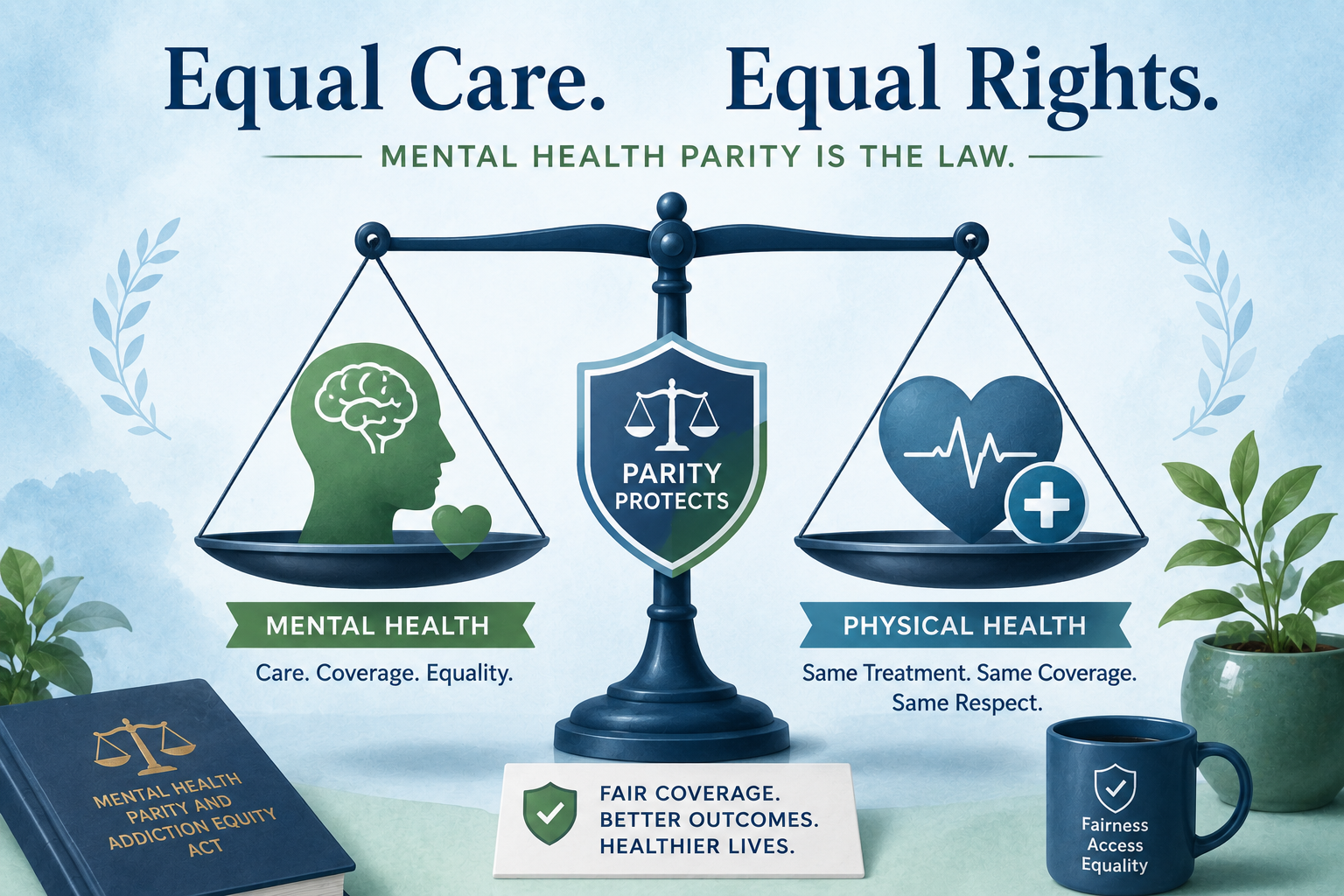
The Mental Health Parity and Addiction Equity Act is one of the most important but least understood patient protections in American healthcare. This federal law requires health insurers to cover mental health and substance use disorder services no more restrictively than comparable physical health services — meaning your insurance cannot apply stricter rules, higher costs, or more limitations to mental health care than to medical and surgical care. Understanding this law gives you powerful leverage when fighting insurance decisions that seem to treat mental health as less important than physical health.
Disclaimer: This content is for educational purposes only. Insurance law is complex and varies by plan type and state. Consult a qualified attorney for advice specific to your situation.
What the Mental Health Parity and Addiction Equity Act Requires
The MHPAEA, originally passed in 2008 and significantly strengthened by subsequent regulations, establishes requirements in three main areas. Financial requirements — copays, deductibles, and out-of-pocket maximums for mental health services must be no higher than those applied to medical and surgical benefits. Quantitative treatment limitations — session limits, visit caps, and day limits for mental health care cannot be more restrictive than comparable limits on physical health care. Nonquantitative treatment limitations — prior authorization requirements, medical necessity criteria, network admission standards, and step therapy requirements must be applied to mental health at least as favorably as to medical and surgical benefits.
The nonquantitative treatment limitations category is where the most significant parity violations occur and where parity arguments are most powerful in appeals. If your insurance requires step therapy (trying less expensive treatments first) before covering a specific mental health treatment, they must apply the same step therapy requirement to comparable physical health treatments — if they do not, that is a parity violation. Read our guide on How to Appeal a Therapy Insurance Denial for how to incorporate parity arguments into your appeal.
Common Parity Violations You May Be Experiencing
Many insurance practices that feel unfair to mental health patients are actually illegal parity violations, though they are often not recognized as such.
Higher copays for mental health visits than for primary care visits of comparable complexity is a parity violation. Many patients pay $50 for a therapy visit while paying $20 for a primary care visit — if the same visit complexity is being compared, this discrepancy may violate parity.
Strict annual session limits for therapy when no comparable limits exist for physical therapy or other ongoing physical treatments is a potential parity violation. If your plan covers 365 days of physical rehabilitation per year but only 30 therapy sessions, this disparity warrants a parity challenge.
Requiring prior authorization for every therapy session when comparable physical health services do not require the same ongoing authorization is a nonquantitative treatment limitation parity violation.
More stringent medical necessity criteria for mental health services than for comparable physical health services — using clinical standards for mental health that are not applied equivalently to physical health — is a frequently litigated parity violation.
How to Build a Parity Argument for Your Appeal
Building an effective parity argument requires identifying a comparable physical health benefit in your plan and demonstrating the disparity in how each is treated. This comparison is the core of any parity argument.
Request your plan’s Summary of Benefits and Coverage and your Evidence of Coverage documents. Review both for mental health benefits and comparable physical health benefits. Look for session limits on therapy versus comparable limits on physical therapy. Look for prior authorization requirements applied to therapy versus physical procedures. Look for different copay structures for mental health versus medical visits.
Once you identify a disparity, your appeal letter should specifically state: “Under the Mental Health Parity and Addiction Equity Act, my plan’s treatment of mental health benefits must be no more restrictive than its treatment of comparable medical and surgical benefits. My plan provides [specific physical health benefit] without [the restriction being applied to mental health]. This disparity appears inconsistent with federal parity requirements.” For complete guidance on writing the full appeal letter, see our guide on How to Appeal a Therapy Insurance Denial.
Who Is Covered by the Mental Health Parity Act
The MHPAEA applies to most private health insurance plans including employer-sponsored health plans with more than 50 employees, individual and small group marketplace plans, Medicare Advantage plans, and Medicaid managed care plans. It does not apply to retiree-only plans, certain grandfathered plans, or plans with fewer than 50 employees if applying parity would increase the plan’s cost by more than one percent. Understanding whether your plan is covered helps you know whether the parity argument is available to you.
How to File a Parity Complaint
If your insurer denies a parity-based appeal, you have regulatory complaint options beyond the internal appeal process. File a complaint with the Employee Benefits Security Administration at dol.gov/agencies/ebsa for employer-sponsored plans. Contact your state insurance commissioner’s office — many states have parity laws that go beyond the federal requirements and active enforcement programs. The Parity Registry at parityregistry.org documents parity violations and can connect you with advocacy resources.
Several states have taken aggressive enforcement action against insurers for parity violations in recent years, resulting in significant changes to insurance practices. Your complaint may not only resolve your individual situation but contribute to broader systemic improvement.
Frequently Asked Questions About Mental Health Parity
Does parity mean my insurance must cover all mental health services? No. Parity means that mental health services that are covered must be covered at least as generously as comparable medical services. It does not require coverage of specific treatments.
How do I know what is a comparable physical health benefit? The comparison is between a mental health service category and a comparable medical or surgical service category within the same benefit classification. Outpatient therapy is compared to outpatient medical care. Inpatient psychiatric care is compared to inpatient medical care.
Can parity help with substance use disorder treatment too? Yes. The Act explicitly covers substance use disorder treatment with the same protections as mental health services.
Conclusion
The Mental Health Parity Act is a powerful legal protection that many patients never use because they do not know it exists. If your insurance treats mental health benefits more restrictively than physical health benefits, you likely have a legal basis to challenge that treatment through the appeals process and regulatory complaints. Combined with the practical strategies in our guides on How to Find a Therapist That Takes Your Insurance and How to Use Out of Network Therapy Benefits, parity knowledge makes you a much more effective advocate for your own mental health coverage.